

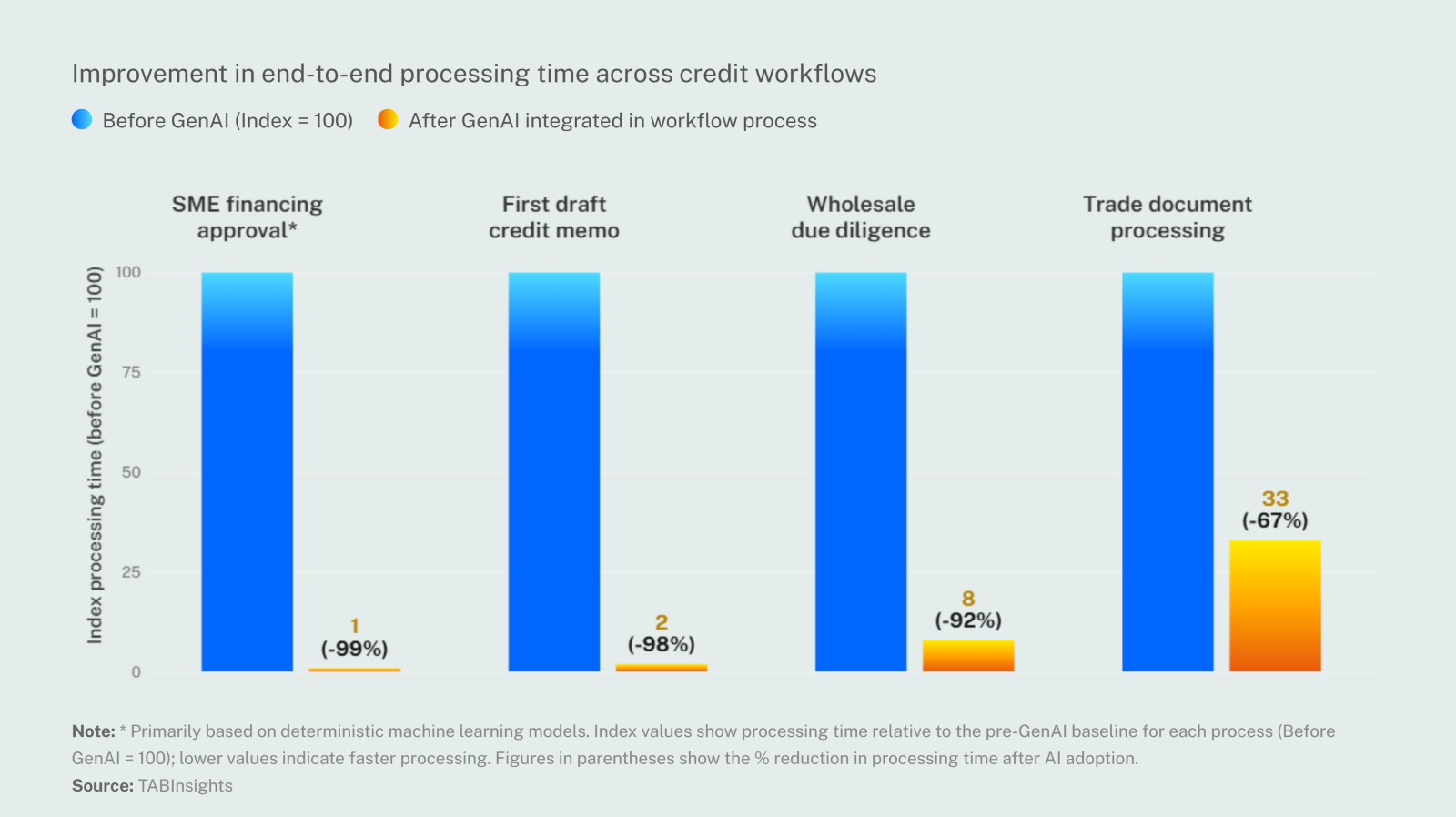

Relationship managers (RMs) in corporate and commercial banking spend, by most industry estimates, no more than a quarter to a third of their week in front of clients. The rest of their time is spent on data entry, document assembly and compliance preparation that increasingly can be handled by machines. Banks putting generative AI into credit application workflows are testing whether that ratio can be reversed, with the strongest implementations cutting a half-day drafting task into minutes. Yet speed is only one part of the case for a credit copilot. The bigger constraint in wholesale and SME credit is not producing the first draft of a credit memo, but getting it through review and approval.
Credit application preparation can take three to four hours of an RM’s time per memo, while the end-to-end application process in wholesale credit can take several weeks to three months. AI drafting tools now in production have cut first-draft generation to minutes, saving tens of thousands of hours annually. But early use also points to a limitation. Where the tool is offered voluntary rather than mandated, relationship managers can choose whether to draft a section of a credit application themselves or let the AI do it. They typically hand only around 20% to 40% of eligible sections to the copilot. This suggests the technology is useful enough to adopt, but not yet reliable enough to trust across the whole process.
Better search matters more than training a custom AI model
Leading banks have found that credit copilots do not work by training a custom AI model on the bank's own past credit papers. That approach is difficult to scale because the reports and disclosures behind a credit application vary too much by sector, market and language for the bank to gather enough consistent examples. Training the system too heavily on past documents can also make it less effective when it encounters unfamiliar material.
Instead, banks are improving how the copilot searches for and ranks information. The system casts a wide net across available documents, then checks whether each result is genuinely relevant rather than merely similar in wording. When a credit copilot gets something wrong, the cause is almost always a bad search result, not a faulty AI model.
This also creates an opportunity to use the same infrastructure across the bank. The search-and-ranking system can support other document-heavy tasks, such as onboarding and trade finance. Banks that build it as shared infrastructure from the outset use far less computing power than those that built a separate system for each department.
A model is only useful if relationship managers trust it
Leading implementations clearly identify AI generated content, cite the source document and page and send low confidence outputs for manual review. This gives relationship managers a clearer way to check the AI's work before relying on it. Adoption therefore depends less on headline accuracy than on how easily users can verify the output.
Tracking usage by section can also show where trust breaks down. If relationship managers consistently choose to write certain sections themselves, banks can identify where the copilot is not yet reliable enough. This can be a more useful measure than a single overall accuracy score.
The biggest time savings may come later in the credit process
When a copilot drafts every credit paper to the same template, approvers can check each one against a consistent structure instead of having to interpret a different format each time. This can reduce the time that credit, risk and compliance teams spend reviewing applications.
It is where the real time savings happen, but banks often count the benefit in the wrong place. They measure the hours saved by relationship managers in preparing the first draft, when the value actually shows up later, in how quickly credit, risk and compliance can review the paper. If a paper still goes back and forth three times before approval, saving four hours on the first draft has limited impact on the overall process. Banks that do not track how many rounds of review each paper needs are therefore measuring only part of the benefit.
Credit oversight is moving from human intervention towards system supervision
Today, AI may draft and analyse the credit paper, but humans, rules and traditional models still sit inside much of the decision process. Regulators often demand strong human oversight, particularly where AI affects consequential decisions such as credit, and banks have therefore tended to keep credit officers directly involved in individual decisions.
That approach provides control, but it can also become a constraint as AI handles information at machine speed. If a person must review every AI output, the process can recreate the bottleneck that automation was intended to remove.
The challenge is therefore to preserve human accountability without making human intervention necessary in every routine case. Credit assessors may increasingly move from being “in the loop”, reviewing or approving individual decisions, to being “on the loop”, supervising how the system operates. Their role shifts towards setting limits, monitoring performance and model drift, testing outcomes, reviewing exceptions and retaining the authority to intervene or override the system where necessary.
Human oversight does not have to mean human intervention in every case. A more sustainable model is one in which machines handle routine decisions within clearly defined boundaries, while humans supervise the system, concentrate on exceptions and remain accountable for its outcomes.
Leading banks are applying the same discipline to the review stage. Before a credit paper is submitted, AI checks it against policy and anticipate the questions that credit and compliance teams are likely to raise. Some onboarding tools already do this by comparing new applications with the questions raised in previous cases, and the same approach can be applied to wholesale credit.
The real test is whether AI shortens the full approval cycle
Banks should run comparable papers through AI-assisted and traditional processes, then measure the number of review rounds, exceptions raised and total time to approval. Drafting hours saved are useful, but they do not capture the full value of the technology.
The more important question is whether AI can improve the economics of the entire credit process as investment begins to scale. Without comparing the two processes from first draft to final approval, banks will struggle to answer it.
Subscribe for regular insights.



Banner.png)



.png)






 Google
  LinkedIn