

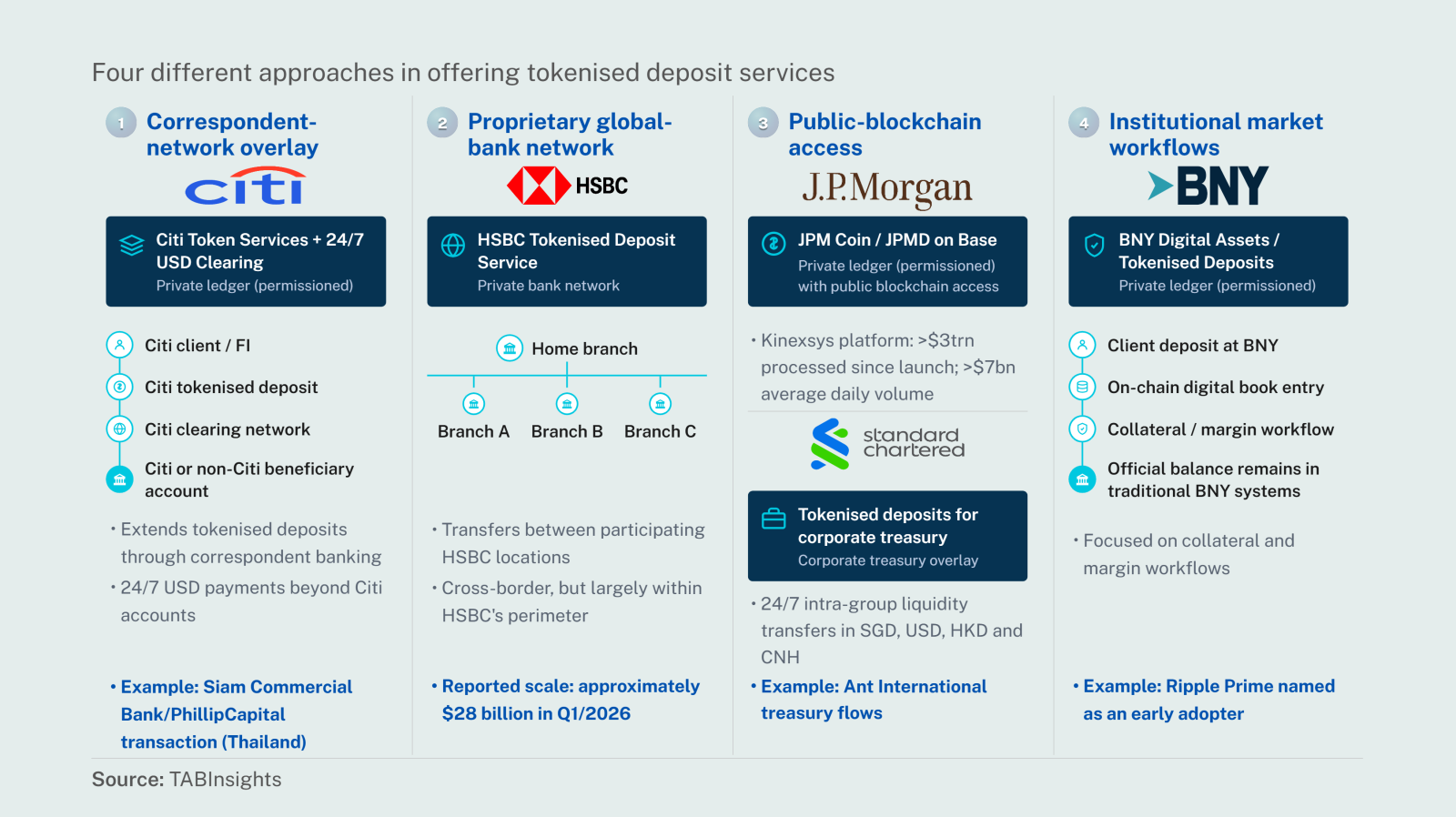

Over a US holiday weekend, PhillipCapital, a customer of Siam Commercial Bank (SCB), transferred US dollars from its Citi account in London to an account with SCB in Thailand. In doing so, SCB became the first financial institution to go live with Citi’s integrated Token Services and 24/7 USD Clearing capability.
The transaction is significant because the payment reached an account outside Citi. Through its USD clearing network, which connects more than 300 financial institutions across over 50 markets, Citi can extend tokenised payments beyond its own customer base. Citi has also reported growing commercial adoption, although it has not disclosed transaction throughput. Since launching in 2024, Citi Token Services for Cash has processed billions of dollars globally and was live in four markets by September 2025.
The operational milestone is significant, but the value of Citi's first-mover advantage warrants closer examination. Citi has not created an open token network that allows deposits issued by different banks to move freely. Instead, it has connected a tokenised deposit on its private ledger to its existing correspondent banking infrastructure. In effect, the token enables always-on transfers within Citi, while its USD clearing network carries the payment on to another bank.
Global banks are pursuing different tokenised-deposit models
The industry's competing claims of being "first" can make these services appear interchangeable, but they are not. While all tokenised-deposit solutions promise faster, round-the-clock movement of money, their underlying models are fundamentally different.
HSBC operates its Tokenised Deposit Service on a private blockchain. Corporate clients convert conventional deposits into digital tokens and transfer them between participating HSBC entities. This gives HSBC a controlled cross-border network, but transfers remain within the bank's own ecosystem. HSBC said clients had processed more than $28 billion in tokenised-deposit payments by June 2026. The service was launched in Hong Kong, Singapore, the UK and Luxembourg by the end of 2025, and by May 2026 its tokenised-deposit and payment capabilities were operating across five markets or regions, including the US.
J.P. Morgan has adopted a different approach by placing its USD deposit token, JPM Coin (JPMD), on Base, a public Ethereum layer-two blockchain, where it is available to institutional clients. While the deposit remains a claim on J.P. Morgan, placing it on a public network is intended to make it easier to interact with blockchain-based assets and applications. Kinexys (formerly Onyx), J.P. Morgan's blockchain business unit and institutional payments network, had processed more than $4 trillion since its launch in 2019 and was averaging more than $7 billion in daily transactions by June 2026. However, these figures relate to the broader Kinexys platform; the bank has not disclosed separate transaction volumes or client numbers for JPMD on Base.
Standard Chartered has taken a different path by applying tokenised deposits to corporate treasury management. It has tokenised Ant International's bank account balances on Ant's Whale treasury platform, enabling 24/7 intra-group liquidity transfers in Singapore Dollar (SGD) and USD in Singapore, and Hong Kong Dollar (HKD), Chinese Yuan Offshore (CNH) and USD in Hong Kong. Unlike Citi's correspondent banking model, the immediate use case is to help a single multinational manage working capital across its own entities. BNY's initial focus has been on collateral and margin management for institutional clients rather than general corporate payments. Its solution creates an on-chain representation of clients' existing deposits on a private ledger, while official balances remain recorded in the bank's traditional systems. This enables programmable cash for institutional market workflows without replacing the bank's existing ledger of record.
Both Standard Chartered and BNY have progressed to commercial or early production use, but neither has disclosed transaction values or daily throughput. Standard Chartered's publicly identified deployment remains centred on Ant International across two markets, while BNY has referred to a broader group of early participants without publishing client numbers or transaction volumes.
These are not identical products competing in the same race. HSBC is building scale within its own international network. J.P. Morgan is connecting bank deposits to a public blockchain. Standard Chartered is embedding tokenised deposits into corporate treasury operations. BNY is applying them to securities and collateral workflows. Citi, meanwhile, is extending token-enabled payments beyond its own accounts through its correspondent banking network.
The available data also highlight the difference between production readiness and commercial scale. J.P. Morgan and HSBC provide the strongest evidence of transaction throughput, while Citi demonstrates growing adoption and the advantage of its correspondent network. Standard Chartered and BNY, by contrast, are harder to evaluate because their disclosures emphasise technical capabilities and specific use cases rather than transaction volumes or commercial adoption.
Citi is preparing for an interoperable future
The main limitation of proprietary tokenised-deposit models for cross-border payments is interoperability. A Citi token cannot move seamlessly with a token issued by HSBC or J.P. Morgan. While each bank can eliminate cut-off times within its own network, it also risks creating a new digital island. Moving value across separate bank ledgers will require shared mechanisms for coordination and payment clearing.
Citi is therefore pursuing two strategies simultaneously. It is commercialising its own solution with SCB while also participating in Swift's shared blockchain ledger initiative. Swift's proposed shared ledger is designed to coordinate bank-issued tokenised deposits across separate ledgers, with 17 banks preparing initial live transactions while final settlement continues to take place through existing payment systems. Citi, HSBC, Standard Chartered and BNY are among the participating banks.
Citi is also supporting The Clearing House's bank-led initiative in the US. The project aims to enable the clearing and settlement of tokenised deposits between banks while connecting blockchain-based transactions to established payment systems such as Real Time Payments (RTP) and The Clearing House Interbank Payments System (CHIPS).
This dual-track strategy is a sensible hedge, but it also raises an important question. If shared infrastructure ultimately allows tokenised deposits issued by different banks to move seamlessly across networks, proprietary ledgers may no longer provide a meaningful competitive advantage at the connectivity layer. Competition would instead shift back to more traditional strengths, including correspondent networks, liquidity, regulatory and compliance capabilities, client onboarding, geographic reach and value-added services.
For SCB, the immediate benefit is clear: its clients can make USD payments outside conventional banking hours, including weekends and public holidays. However, that capability remains tied to Citi's ledger, liquidity and USD clearing network.
Citi's first-mover advantage is best understood as a demonstration of distribution rather than a decisive lead in tokenisation. Whether that advantage endures will depend on its ability to convert its correspondent banking network into sustained client adoption and transaction scale before shared infrastructure standardises the connectivity layer. Ultimately, the next phase of competition will be defined not by who executes the first live transaction, but by which model can connect bank-issued money across networks without creating new liquidity silos or dependence on a single provider.
Subscribe for regular insights.



Banner.png)



.png)






 Google
  LinkedIn