

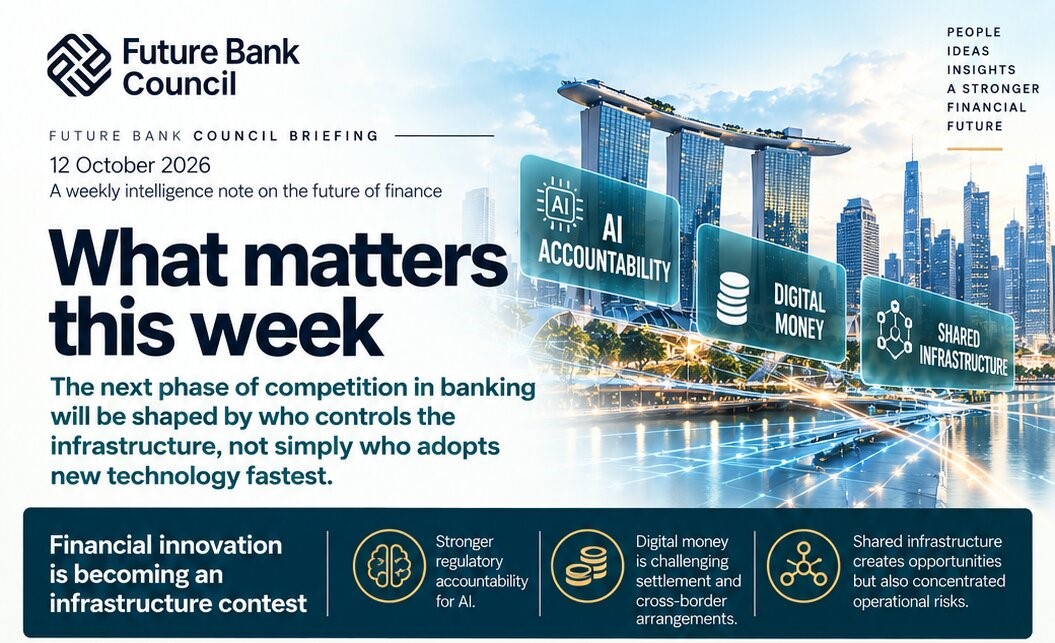

Financial innovation is becoming an infrastructure contest
• Regulators are demanding stronger accountability as artificial intelligence moves into critical financial processes.
• Digital money is challenging existing arrangements for settlement, liquidity and cross-border payments.
• Shared technology infrastructure is creating opportunities while exposing banks to concentrated operational risks.
Top stories
1. Singapore makes banks accountable for artificial intelligence they do not control
Southeast Asia | 7 October 2026
Artificial intelligence governance becomes a board-level obligation
The Monetary Authority of Singapore (MAS) has issued guidelines requiring financial institutions to manage artificial intelligence (AI) risks across their organisations, including systems developed or operated by external providers. The framework covers board oversight, risk assessment, model inventories, testing, monitoring and human intervention. It will take effect in phases from October 2027, with further requirements beginning in October 2028. Ho Hern Shin, deputy managing director of MAS, stressed that responsible adoption requires institutions to understand the risks arising from increasingly capable AI systems. The guidelines reflect a growing regulatory concern that banks are expanding their use of autonomous technology faster than their governance frameworks are developing.
External technology does not transfer responsibility
The deeper implication is that banks cannot outsource accountability simply because an AI system is supplied by a third party. MAS expects institutions to obtain adequate assurance from providers and impose additional controls where necessary. Banks that cannot establish whether an application operates within their risk appetite may need to restrict or replace it. This could change how institutions procure AI technology, particularly where vendors cannot explain model behaviour or provide sufficient access for oversight. Singapore is establishing a supervisory precedent in which the ability to identify, monitor and interrupt AI-driven activity becomes part of a bank's core operational capability.
Where this leads: Over the next three to five years, banks with stronger AI governance could gain an advantage in deploying autonomous financial services at scale.
2. Singapore challenges banks to move tokenised finance beyond isolated networks
Southeast Asia | 9 October 2026
Digital assets cannot achieve scale without trusted settlement
Singapore is shifting its attention from demonstrating tokenisation to establishing the conditions for commercial adoption. In an address on 9 October, Chia Der Jiun, managing director of MAS, argued that digital assets, digital money and financial infrastructure must develop together. Tokenised bank deposits, regulated stablecoins and central bank digital currencies could serve different purposes, but they need reliable settlement arrangements and common standards. MAS is also preparing to settle tokenised MAS Bills using wholesale central bank digital currency, extending its work to connect digital assets with central bank money.
Interoperability will determine whether tokenisation creates economic value
The strategic issue for banks is that tokenising an asset does not necessarily make it more liquid or easier to trade. A platform operating independently from other institutions may transfer assets efficiently within its own network while remaining disconnected from wider financial markets. MAS expects a network of interconnected platforms rather than a single global ledger, and is developing standards through its Global Layer One initiative. This could require banks to rethink investments in proprietary tokenisation networks, particularly where those systems cannot exchange assets, money or transaction information with external counterparties. Institutions that develop trusted connectivity could benefit more than those building technically sophisticated but isolated platforms.
Where this leads: Tokenisation could favour banks that can connect multiple settlement networks while maintaining access to central bank money.
3. Hong Kong and Malaysia test the regulatory foundations of cross-border stablecoins
East and Southeast Asia | 6 October 2026
Bilateral cooperation moves digital money towards practical applications
The Hong Kong Monetary Authority (HKMA) and Bank Negara Malaysia have agreed to establish a joint policy workstream examining compliant cross-border stablecoin applications. Announced on 6 October following a high-level meeting, the cooperation also covers tokenisation, digital money, local-currency transactions and Islamic finance. Eddie Yue, chief executive of HKMA, linked the agreement to closer cooperation in financial innovation and market connectivity. The development suggests that regional regulators increasingly recognise the need to coordinate their approaches before digital money can move reliably across national payment systems and legal jurisdictions.
Regulatory differences remain a barrier to commercial use
The agreement does not create a functioning stablecoin payment corridor, but it offers a route towards addressing obstacles that individual banks and payment companies cannot resolve. Cross-border stablecoin transactions raise questions about reserve assets, redemption rights, regulatory recognition and responsibility when payments involve multiple jurisdictions. Banks serving companies operating between Hong Kong and Malaysia could eventually benefit from more efficient treasury and settlement arrangements, provided those issues are resolved. The inclusion of local-currency transactions and Islamic finance also gives the cooperation a broader commercial dimension than digital assets alone, particularly for institutions serving regional trade and investment flows.
Where this leads: Bilateral agreements could provide an alternative path towards cross-border digital-money interoperability where broader international standards develop slowly.
4. Europe sees the digital euro as a foundation for payments competition
Europe | 6 October 2026
Public payment infrastructure could reduce dependence on international providers
The European Central Bank (ECB) is positioning the digital euro as part of a broader effort to modernise European payments while preserving the role of central bank money. Speaking on 6 October, Piero Cipollone, member of the ECB's executive board, explained how the digital euro, tokenised settlement infrastructure and private financial innovation fit into a common strategy. The central bank aims to provide a shared foundation on which commercial banks and payment providers can develop services. Preparations include a planned 12-month pilot beginning in the second half of 2027, involving 36 selected payment service providers. A decision on issuance will follow the adoption of legislation, with potential issuance targeted for 2029.
Banks will compete through services rather than ownership of payment networks
The commercial implication is that public infrastructure could change how European payment providers compete. A common acceptance framework would allow institutions to develop services without independently building comprehensive payment networks across national markets. It could also reduce Europe's dependence on international card schemes while preserving banks' customer-facing roles. Cipollone emphasised that the ECB does not intend to replace private-sector innovation. The uncertainty is whether a public payment platform can achieve widespread adoption without undermining existing commercial incentives. Banks will need to assess how the digital euro fits alongside deposits, cards, instant payments and their existing payment businesses.
Where this leads: A widely adopted digital euro could shift payment competition towards customer relationships, distribution and the services built around transactions.
5. Britain's cloud outage exercise exposes the limits of individual bank resilience
United Kingdom | 9 October 2026
Shared infrastructure creates risks that individual banks cannot resolve
The Bank of England has completed a sector-wide simulation examining how financial institutions would respond to a disruption affecting global cloud services. Conducted on 8 October and announced the following day, SIMEX26 involved 38 large and systemically important banks and market infrastructure operators. Participants worked alongside financial authorities to test crisis management and coordination under severe operational disruption. Katharine Braddick, deputy governor for prudential regulation at the Bank of England, described the exercise as a demonstration of the industry's commitment to maintaining critical services. The exercise reflects a growing concern that financial institutions increasingly depend on common technology providers, creating vulnerabilities that extend beyond their own operating environments.
Recovery depends on counterparties and infrastructure remaining available
A bank may have strong internal business continuity arrangements and still struggle to maintain services if its counterparties, cloud providers or market infrastructure operators are unavailable. The exercise therefore addressed a problem that cannot be resolved solely through individual disaster recovery plans. The Bank expects participating firms to strengthen their preparedness following the simulation. For banks, the strategic question is how much operational concentration can be accepted in exchange for the efficiency and scalability of outsourced technology. Resilience assessments will need to consider whether critical financial services can continue when multiple institutions experience a common disruption, rather than assuming that each organisation's recovery arrangements operate independently.
Where this leads: Supervisors could increasingly assess operational resilience across shared providers and market networks rather than concentrating on individual institutions.
6. Hong Kong expands trade finance through cross-border data connectivity
East Asia | 5 October 2026
Trade information is becoming infrastructure for credit decisions
The HKMA is expanding efforts to connect shipping, customs and commercial data with banks' trade finance processes. At its CargoX Solution Day on 5 October, deputy chief executive Howard Lee explained how Hong Kong's Commercial Data Interchange (CDI) is being extended towards regional trade data connectivity. The platform connects 17 data sources and 28 banks, enabling businesses to share information with financial institutions. According to HKMA research, banks making greater use of alternative data through CDI charge interest rates averaging 36 basis points lower. The initiative addresses a persistent problem in trade finance: lenders often lack reliable and timely information about smaller companies' commercial activities.
Better information could change which businesses obtain financing
The regional expansion is especially relevant to trade between Hong Kong, mainland China and Southeast Asia. Pilot banks have begun accessing trade declaration information from the Yangtze River Delta through a connection with Shanghai's digital trade infrastructure, improving verification and supporting faster loan drawdowns. Hong Kong is also pursuing cooperation with the PAA Digital Trade Alliance to extend connectivity across the region. The competitive opportunity lies in allowing banks to assess financing requests using verified trade activity rather than relying primarily on financial statements and collateral. Institutions able to incorporate these external data sources into credit decisions could reach businesses that conventional underwriting methods have struggled to serve.
Where this leads: Regional trade data networks could make transaction-level information an increasingly important foundation for small-business lending and supply chain finance.
7. The Bank of England warns that repeated shocks are testing financial resilience
United Kingdom | 8 October 2026
Financial stability is becoming harder to maintain in a fragmented global economy
Andrew Bailey, governor of the Bank of England, has warned that financial institutions face a more difficult environment as geopolitical disruption, weaker economic growth and financial market vulnerabilities interact. Speaking in Istanbul on 8 October, Bailey argued that banking systems have remained resilient despite successive shocks, supported by stronger capital positions and reforms introduced after the global financial crisis. The concern is that future disruptions may be more frequent and increasingly interconnected. Rising sovereign debt, leveraged financial markets and growing investment exposure to artificial intelligence could amplify losses if economic conditions deteriorate or market expectations change abruptly.
Strong bank capital cannot eliminate vulnerabilities beyond the banking system
Bailey highlighted changes in government bond markets, where leveraged investors now play a larger role in absorbing debt issuance. These investors can provide additional market capacity during normal conditions, but rapid deleveraging could intensify price movements during periods of stress. The growing financial exposure to AI introduces another uncertainty if expectations about its economic returns are revised sharply. Banks therefore face risks that originate outside their traditional lending businesses but can still affect collateral values, funding conditions and market liquidity. The broader message is that resilience must extend beyond bank balance sheets to the structures through which financial institutions obtain liquidity, manage exposures and interact with capital markets.
Where this leads: Financial institutions could face greater pressure to assess how market liquidity, sovereign debt exposures and AI-related investment risks interact under stress.
8. Britain moves to prevent outdated regulatory thresholds from constraining bank growth
United Kingdom | 7 October 2026
Fixed regulatory boundaries can increase compliance costs without a policy change
The UK's Prudential Regulation Authority (PRA) has proposed automatically adjusting 128 regulatory thresholds in line with nominal gross domestic product. Announced on 7 October, the proposal covers banks, insurers and credit unions, with the aim of reducing the need for periodic manual changes to regulatory limits. The thresholds determine which rules apply to institutions and what information they must report. Katharine Braddick, chief executive of the PRA, argued that automatic adjustments would provide greater stability and predictability for financial institutions. The initial adjustment would take place in July 2031, followed by further updates every five years, subject to the outcome of consultation.
Predictable regulation could change the economics of expansion
The proposal is particularly relevant to smaller institutions approaching thresholds that trigger additional regulatory obligations. Fixed monetary limits can become more restrictive over time as inflation and economic growth increase the nominal size of financial activity. Linking selected thresholds to economic conditions could reduce unnecessary reporting costs and make business planning more predictable. The PRA is not proposing to abandon prudential safeguards, but to reconsider how regulatory boundaries should adjust as the economy changes. For smaller banks, this could influence decisions about expansion and investment by reducing uncertainty over when additional compliance requirements will apply. The consultation remains open until 7 February 2027.
Our view
We believe banks are approaching a period in which control over financial infrastructure will matter as much as the products they offer. This week's developments show how responsibility is being redistributed across financial institutions, technology providers and public authorities. Central banks are becoming more involved in the architecture of digital money, while supervisors expect banks to retain accountability for increasingly autonomous systems. These changes challenge a long-standing assumption that institutions can improve efficiency through outsourcing and automation without fundamentally changing how they govern their businesses.
The competitive implications are substantial. Banks have historically derived influence from their balance sheets, customer relationships and access to payment infrastructure. As financial activity moves across connected networks, some of these advantages could weaken. Technology providers may control critical operating capabilities, while common settlement infrastructure could reduce barriers for new competitors. We expect banks to place greater value on interoperable technology, direct access to reliable settlement arrangements and the ability to maintain services during disruptions affecting multiple institutions. The institutions most exposed will be those whose technology strategies have expanded faster than their capacity to manage dependencies.
Our view is that regulation will increasingly favour banks that can demonstrate institutional control rather than technological ambition alone. AI deployment will need to be accompanied by stronger accountability, while digital money must remain connected to trusted forms of settlement. The next wave of financial innovation will therefore demand investment in capabilities that are less visible to customers but essential to delivering financial services reliably. Banks that treat these capabilities as strategic assets could gain an advantage over competitors focused primarily on launching new products.
The future of banking will be shaped not only by what institutions can build, but by what they can continue to control.
Russell P
TAB Global




Banner.png)



.png)






 Google
  LinkedIn