

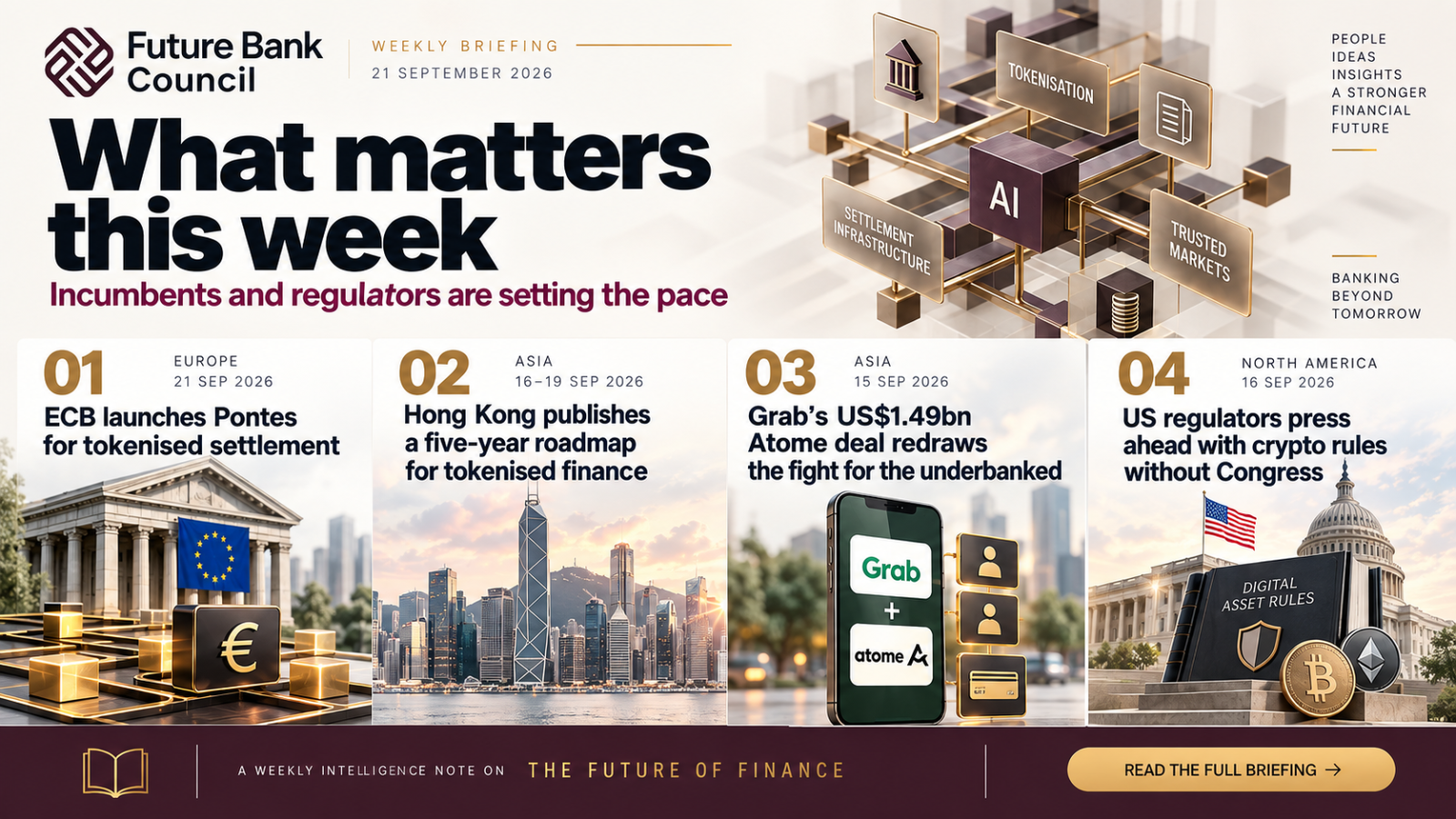

Incumbents are setting the pace, not following it
- A central bank went live with infrastructure it built, not licensed out.
- Two US regulators chose to act before the law caught up.
- A non-bank platform bought lending infrastructure banks had not built.
Top stories
The ECB proved a central bank can build market infrastructure on its own clock
Europe | 21 September 2026
The Eurosystem's Pontes platform went live today
The European Central Bank's Pontes settlement service began operating on 21 September, letting distributed ledger technology platforms settle tokenised securities transactions in central bank money. It connects market platforms to the Eurosystem's TARGET payment infrastructure rather than requiring commercial intermediaries.
The bank chose to build rather than wait for private rails to mature
Pontes gives banks and market infrastructures a route to settle tokenised trades without relying on private stablecoins or bank-issued tokens for finality. European Central Bank President Christine Lagarde described it as "a digital euro made available to banks so that they can carry out transactions between themselves using tokenised assets and distributed ledger technology," and pressed lawmakers to finalise digital euro legislation "as soon as possible before the end of 2026."
The timing question now sits with politicians, not technologists
Pontes works today. The retail digital euro that would extend this logic to consumers still needs legislation Lagarde wants passed this year. Banks planning around tokenised settlement should treat the technical risk as largely retired and the political risk as the one still open.
Hong Kong published a five-year calendar banks now have to build against
Asia | 16-19 September 2026
Hong Kong set out its first five-year plan for tokenised finance
Financial Secretary Paul Chan announced a five-year roadmap covering artificial intelligence governance, stablecoin oversight, and tokenised Exchange Fund Bills, with a pilot Chan said "will commence by the end of 2026." A new Commissioner for Artificial Intelligence post and a digital asset platform inside the Central Moneymarkets Unit are both part of the plan.
A financial centre is now setting dates other jurisdictions will be measured against
Naming an end-of-2026 pilot date turns tokenisation from an ambition into a deliverable banks operating in Hong Kong must plan around. Regional competitors without an equivalent calendar now look less prepared by comparison, whether or not that comparison is fair.
The plan is a commitment device as much as a policy paper
A published date is harder to quietly abandon than a consultation response. Banks with Hong Kong operations should expect the Commissioner for Artificial Intelligence role to become a genuine supervisory contact point, not a symbolic appointment.
Grab's $1.49 billion bet says the fight for Southeast Asia's underbanked has a new owner
Asia | 15 September 2026
Grab is buying majority control of a buy-now-pay-later lender
Grab agreed to acquire a sixty per cent controlling stake in Atome Financial for one point four nine billion US dollars, combining its super-app platform with Atome's artificial-intelligence-powered lending infrastructure across Southeast Asia.
A non-bank platform is now the largest single acquirer of consumer credit infrastructure in the region
Grab President and Chief Operating Officer Alex Hungate said the deal would "deliver on our common vision of using technology to responsibly extend financial access to the unbanked and underbanked in the region." Atome chairman and chief executive Jefferson Chen said the combination would "extend that to millions more across Southeast Asia who've been left out."
Banks should read this as a scale move, not a bolt-on
Grab Chief Financial Officer Peter Oey said the deal is funded entirely from existing cash and would not affect Grab's share buyback programme, a sign of confidence rather than financial strain. Banks competing for underbanked customers in Southeast Asia now face a well-capitalised platform rival with lending infrastructure already built.
Two US regulators said they will write crypto rules without Congress
North America | 16 September 2026
The Senate's Clarity Act vote failed, so regulators moved instead
After the Senate voted forty-nine to fifty against the Clarity Act, Securities and Exchange Commission Chairman Paul Atkins and Commodity Futures Trading Commission Chairman Mike Selig both said their agencies would proceed with crypto rulemaking on their own authority rather than wait for fresh legislation.
Rulemaking without statute is faster but more exposed to challenge
Atkins said the Securities and Exchange Commission would "act decisively within the SEC's statutory authority to deliver certainty." Selig said his agency was "locked in and ready to ship its rules for the new frontier of finance." Both chairs are choosing speed over the durability that legislation would have given the rules.
Banks now face regulatory rules that could be litigated, not just legislated
Rules built on existing statutory authority are more vulnerable to court challenge than rules written into new law. Banks building crypto and digital asset businesses around this rulemaking should plan for the possibility that some of it does not survive litigation intact.
Nubank entered the United States before its own bank charter cleared
Latin America | 15 September 2026
Brazil's largest neobank launched a US multicurrency, stablecoin-linked account
Nubank's Nu Global business began offering US customers a multicurrency account with a stablecoin-linked component, ahead of the Office of the Comptroller of the Currency's decision on its pending national bank charter application. The launch used an existing partner bank relationship rather than waiting for the charter.
A neobank is treating charter approval as a formality, not a gate
Nu's US chief executive Cristina Junqueira said "entering the U.S. is a strategic step in Nu's evolution into a global digital financial services platform," and pointed to more than 140 million customers across Latin America as the base the group is now building beyond.
The sequencing itself is the strategic signal
Launching before the charter clears tells competitors and regulators that Nubank expects approval and is not prepared to lose market time waiting for it. US banks watching this entrant should note that the charter delay did not slow the product.
State examiners now have a common playbook for grading banks on artificial intelligence
North America | 17 September 2026
The Conference of State Bank Supervisors released a common examination framework
The Conference of State Bank Supervisors published its Artificial Intelligence Supervisory Framework, giving state examiners a shared, principles-based tool for assessing how banks and nonbanks deploy artificial intelligence. It follows approval by the organisation's supervisory committees the previous month.
A voluntary tool fills a gap federal regulators have left open
Conference of State Bank Supervisors chief executive Brandon Milhorn described it as "a principles-based approach... intended to help financial institutions explore and implement artificial intelligence with additional confidence." No equivalent federal framework currently exists, leaving state examiners to set the practical standard.
Voluntary today does not mean voluntary indefinitely
A framework adopted by enough states tends to harden into a de facto national standard, federal action or not. Banks operating across state lines should treat this as the baseline examiners will reach for, whether or not their home state has formally adopted it.
Partior and LSEG just made bank-backed settlement rails interoperable with mainstream market infrastructure
Asia | 17 September 2026
Two infrastructure providers linked their networks for round-the-clock settlement
Partior, the bank-backed digital ledger payments network, agreed to connect with LSEG's Digital Markets Infrastructure platform, DiSH, to bring always-on settlement bank liquidity to Partior's cross-border payments network.
Interoperability, not a new platform, is the actual signal
Partior chief executive Humphrey Valenbreder said the partnership "unlocks immediate, tangible value for our customers today." LSEG Post Trade Solutions chief executive Andrew Williams described DiSH as providing "the neutral, trusted third-party option required to connect independent payment ecosystems securely."
Banks do not need to choose a single rail if the rails can talk to each other
This reduces the pressure on banks to bet on one tokenised settlement network over another, since interoperability lowers the cost of being on the losing side of that choice. Institutions still weighing which digital settlement infrastructure to join now have one fewer reason to delay.
Absa asked competitors to share fraud data instead of guarding it
Africa | 16 September 2026
Absa called publicly for South African banks to pool fraud intelligence
Absa executives urged South African banks to share fraud and mule-account intelligence rather than treat it as competitive advantage, citing a forty-four per cent rise in deepfake-enabled social engineering fraud and a thirty-eight per cent rise in consumer scams over two years.
The bank is naming a coordination failure other banks would rather not discuss
Chief Compliance Officer Fatima Newman and Group Chief Governance Officer Prabashni Naidoo both made the case publicly, an unusual step for a bank naming a shared weakness rather than a shared achievement. Absa's own digital customer base grew fourteen per cent to five point four million.
A public call for cooperation is also a public admission of exposure
Making this argument in public raises the reputational cost of other banks declining to participate. It also signals that Absa's internal fraud controls alone are not keeping pace with the growth in deepfake-enabled attacks.
Mexico's banks are already organising around a digital payments law still in draft
Latin America | 18 September 2026
Mexico's banking association is coordinating with government ahead of the law passing
President Claudia Sheinbaum's proposed digital economy law would push cash-heavy sectors toward digital payments, starting with fuel stations and road tolls. Emilio Romano, president of the Mexican Banking Association, said the association was "working very closely with the government" on bringing fuel and toll payments into digital form.
Banks are moving before the legislation is finalised
Coordinating implementation ahead of a law passing is efficient if the law passes largely as drafted, and a wasted head start if it does not. The banking association's early involvement suggests it expects the fuel and toll provisions to survive the legislative process largely intact.
Execution risk sits with infrastructure, not intent
Toll roads and fuel stations are not natively digital-payments environments, and hardware and connectivity gaps could slow adoption regardless of how the law is written. Banks should watch implementation timelines more closely than the legislative text itself.
Ant International says most of its merchant network is now running on artificial intelligence agents
Asia | 18 September 2026
Ant International reported rapid adoption of artificial intelligence agents across its payments network
Ant International said eighty-nine point five per cent of Antom merchants deployed artificial intelligence agents over the past year, with the agents now assisting eighty-one point four per cent of payment tasks. The network spans fifty-three digital wallets and more than twenty-five million daily transactions across two hundred and ten markets.
The company is positioning itself as infrastructure, not just a processor
Ant International chief executive Peng Yang framed the shift around a new "Account for Agent" business account designed for merchants operating through artificial intelligence agents rather than staff. Chargeback rates fell by as much as eighty-seven per cent on the platform's newest service tier.
Self-reported adoption numbers deserve scepticism, not automatic acceptance
These figures come from Ant International itself, with no independent audit cited. The direction, agentic commerce moving from pilot to majority use inside one network, is still a competitive signal banks in payments and merchant acquiring should not ignore.
Our view
We think banks are underestimating how much of this week's agenda was set by regulators, central banks and non-bank platforms acting alone, not waiting for market consensus or new legislation. The European Central Bank did not wait for the digital euro law to pass before launching Pontes. The Securities and Exchange Commission and Commodity Futures Trading Commission did not wait for the Senate to try again on the Clarity Act. Grab did not wait for banks to build competing lending infrastructure before buying a majority stake in a business that already had it. Banks that treat regulatory clarity or platform competition as something to respond to later are consistently arriving after the infrastructure, the rules and the capital have already moved.
We are also sceptical that either Absa's public call for fraud-data cooperation or Ant International's self-reported adoption statistics will move as fast as their announcements suggest. Cooperation among competing banks tends to stall on liability and data-sharing terms long after the public commitment is made, and adoption figures reported by the company benefiting from them warrant independent verification before banks treat them as a market benchmark.
Nubank's decision to launch in the United States ahead of its own charter clearing, and Grab's willingness to spend $1.49 billion in cash on a controlling stake rather than build lending infrastructure from scratch, are the clearest signals in this issue that speed now outweighs sequencing for the institutions setting the pace. Banks slower to move risk discovering that market position, once ceded this way, is harder to reclaim than the capital or the charter itself was to obtain.
Russell P,
TAB Global



Banner.png)

.png)






 Google
  LinkedIn