


This year's TAB Global Financial Technology Innovation Awards tell a story about foundations, not mere features. Across the entries, the clearest signal is a shared conviction: the banks best positioned over the next three to five years will be the ones that have rebuilt what sits underneath – their data, architecture, risk and rails — to support intelligent, agile and real-time banking.
Where banks are placing their technology bets
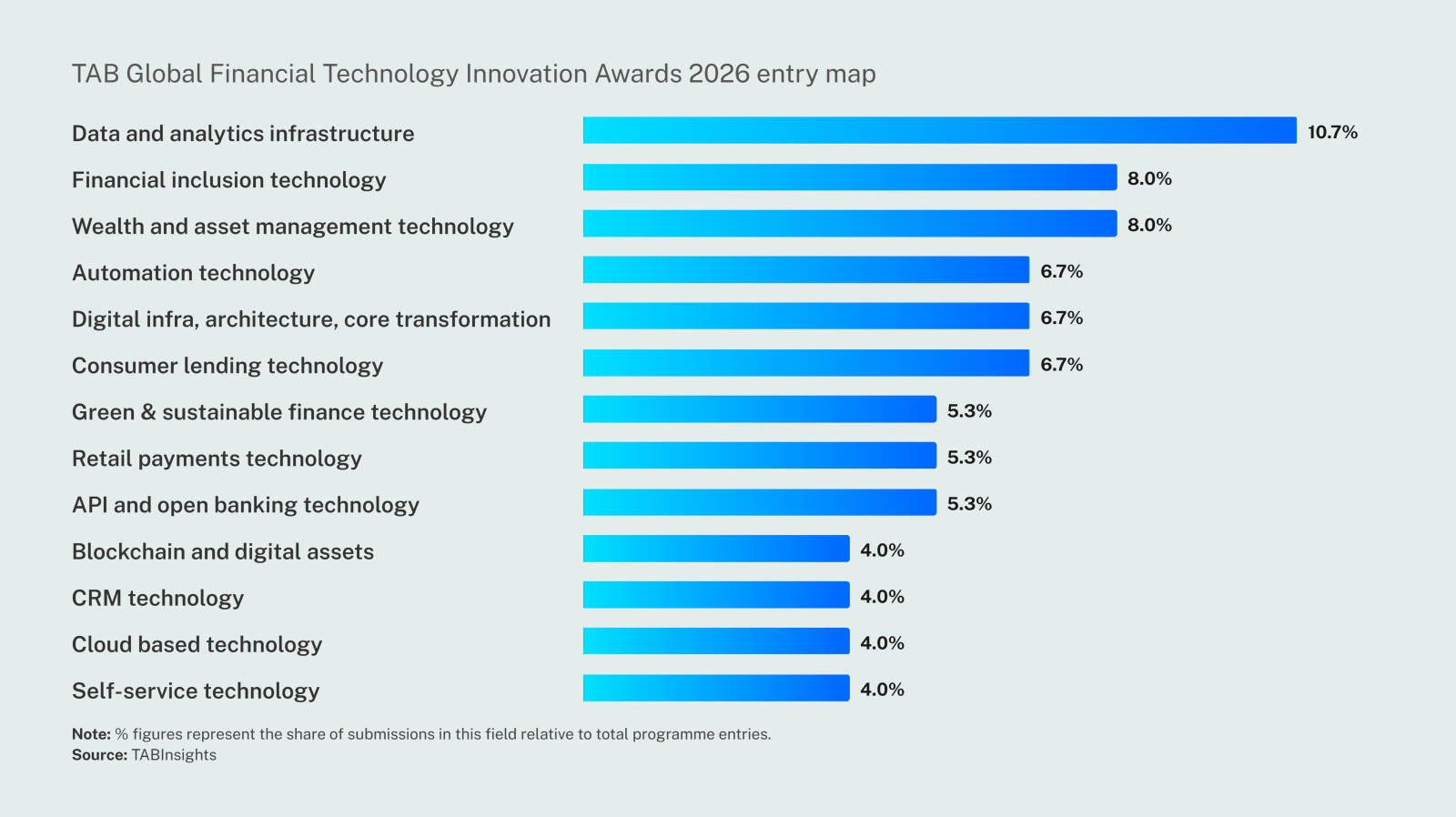
This year’s TAB Global Financial Technology Innovation Awards and Risk Technology Awards drew 97 entries. The submissions, and the conversations with the banks behind them, point to a foundational shift from surface-level digitisation to structural transformation, as bank rewire their technology for the next phase of digital banking.
This isn't a story about any single technology, but about the strategic infrastructure choices banks are making now. Six trends stand out.
1. Data foundations are becoming banks' core infrastructure investment
Leading banks treat data architecture as a strategic asset rather than background plumbing. The quality of a bank's data foundation determines how far downstream capabilities such as AI-led analytics, personalisation and automation can reach into the operating model. Customers expect contextual, real-time experiences wherever they engage. Increasingly, the real differentiator for intelligent banking is not the sophistication of the model sitting on top, but the quality of the data feeding it.
Getting the data foundation right means solving several problems. First, breaking down silos so that applications across the bank can draw on integrated and scalable information. Second, building real-time rather than batch data flows to support faster decisions. Third, restructuring data so relationships between records can be queried and reasoned over. Finally, embedding strong data governance from the outset rather than retrofitting it.
China's Industrial Bank replaced fragmented data warehouses with a unified enterprise architecture spanning ingestion, governance, real-time processing and analysis connecting over 300 systems. China Construction Bank has taken the real-time question further. Its stream-batch data lake unifies real-time and batch processing, moving the bank's operating model from T+1 analysis to T+0 decisioning, with integrated data across 179 source subsystems and 62 business domains.
Richer data enables banks to reach newer market segments. Through multi-source data integration, a unified risk engine and proactive credit assessment algorithms, China Minsheng improved its financial services offerings for small and micro enterprises (SMEs) expanding access to inclusive finance.
2. Real-time, composable architecture is essential for strategic optionality
Speed is now the constraint. Technology cycles are moving faster than bank planning horizons. Legacy systems are challenged by higher costs, slower innovation and weaker resilience. Tomorrow's architecture needs to be real-time, scalable and agile enough to support whatever runs on top of it next — agentic AI, digital currencies, tokenisation, blockchain and workloads that don't exist yet. Banks recognise the need for urgent digital transformation but must modernise decades-old systems while still meeting resilience and regulatory obligations.
Banks increasingly treat cloud migration as an architectural necessity rather than a cost play. AI and instant decisioning are difficult to support on batch-based, on-premise rails. That shift is happening faster at the front end, while migration of core systems to cloud remains selective — many banks still opt for on-premise or private cloud for critical systems on regulatory and security grounds.
In parallel, banks are moving core systems from tightly coupled monoliths to decomposable, application programming interface (API) connected microservices that can be built and scaled independently. The multi-year rip-and-replace model is giving way to progressive modernisation through modular layers particularly for larger banks.
Transformation is taking varied forms. Digital banks such as GXBank, Tonik, Trust Bank and Mox are born cloud-native while others adopt cloud progressively. Bank Muamalat's ATLAS undertook a full migration from on-premise to a composable, software as a service (SaaS) based, cloud-native stack, integrating onboarding, payments, financing and lifestyle services. Tonik Digital Bank implemented cloud-based lending platform for end-to-end digital loan origination, credit decisioning and disbursement. Banks are working through multi-cloud, hybrid public-private models, with the mix shaped by regulatory comfort, data residency, risk appetite and legacy complexity.
As payments and transactions move to real time, the rails underneath need to keep pace. Security Bank consolidated fragmented payment systems into a single, ISO 20022-based platform supporting real-time processing, enabling higher efficiency and greater reliability. Fintechs are increasingly supplying the speed and scale in payments. NIUM's cloud-native, API-first infrastructure facilitates high scalability, automation and regulatory integration in cross-border payments across over 190 countries.
3. Risk, fraud, compliance and trust are becoming competitive infrastructure
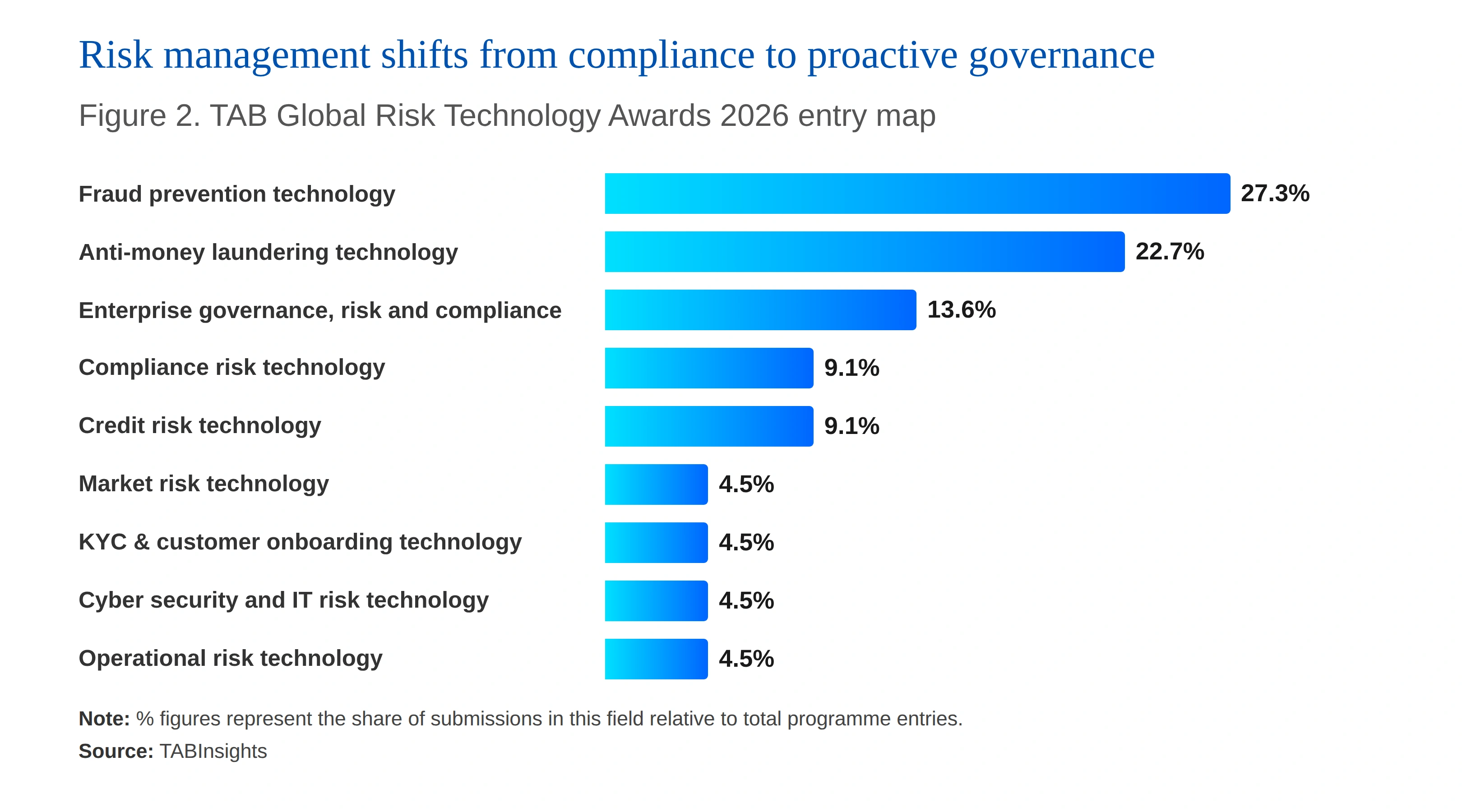
Risk and compliance no longer sit outside the growth agenda. As fraud grows more adaptive and regulators scrutinise models and controls more closely, banks are moving to governance by design. Banks are increasingly building governance directly into the data architecture, with lineage, access control and drift monitoring embedded rather than bolted on. Resilience is proving as important as detection. They are designing systems to fail safely, building in stronger resilience and faster recovery as newer cyber threats emerge.
Shanghai Pudong Development Bank (SPDB) built a technology-driven supervision and resilience platform that combines real-time monitoring, a microservices architecture and multi-site recovery into a single framework, delivering custodial-level supervision over its internet fund distribution business with no service disruption. Separately, the bank developed an enterprise-wide model risk framework that integrates automated credit decisioning, lifecycle governance and continuous monitoring across its digital risk models.
Identity verification is shifting to a real-time control rather than a one-off gate at onboarding. Leading banks are cutting onboarding time by using digital KYC, paired with digital document and liveness checks with real-time screening.
As novel and sophisticated cyber threats emerge, banks are placing greater emphasis on real time and proactive monitoring. Regulatory oversight is strengthening too. Bank Indonesia launched a new platform that unifies cyber maturity assessment, incident reporting, critical infrastructure mapping and analytics into one supervisory operating model across the institutions it oversees, providing early visibility into emerging cyber risk.
Several structural shifts sit beneath these examples. As fraud vectors grow more sophisticated, static, rules-based detection is giving way to continuous, AI-led, behaviour-based and network-level controls. And because fraud increasingly moves through shared infrastructure, interbank intelligence-sharing is becoming as important as any single institution's own defences.
4. Process infrastructure is consolidating into self-orchestrating pipelines
Process transformation is graduating from point automation to consolidated pipelines that connect building, testing, launching and monitoring into one continuous, governed flow instead of a series of disconnected steps. The shift is architectural as much as operational. Banks are replacing siloed automation tools with unified orchestration layers that sit across systems.
Cathay United Bank's automated cloud platform links testing, deployment and monitoring into one governed pipeline. China Everbright Bank has taken the same logic to fraud. It has transformed fraud detection from a reactive control function into a continuous closed-loop risk management capability encompassing monitoring, intervention and strategy optimisation.
The deeper shift is organisational, not just technical. As automation absorbs the routine, human effort concentrates on judgement and oversight rather than execution. That isn't just a technology rollout. It requires genuine workflow and workforce transition, redesigned operating models and deliberate reskilling for human-AI collaboration.
5. Banks are repositioning as embedded, interoperable infrastructure
Banks now generate value through new channels. Rather than relying on direct customers alone, they are strategically choosing to become the layer that other platforms plug into. Leveraging Banking-as-a-Service and open APIs, banks are embedding payments, credit and insurance directly into non-financial apps and e-commerce platforms, allowing customers to transact without leaving those applications. The competitive advantage comes from the scale of ecosystem connectivity.
Ethiopia-based Ethswitch built national interoperable payments infrastructure, connecting banks, merchants and individuals on shared rails to reduce fragmentation and broaden access to digital financial services at national scale.
Customer acquisition in virtual cards and lending is expanding through partnerships with e-wallet and e-commerce platforms. Banks are also using ecosystems to expand into adjacent product lines. ICBC implemented wealth management capabilities with multi-module ecosystem architecture and integration with resources from dozens of external partner institutions, providing access to major asset classes and matching products to customer needs.
6. Digital assets and blockchain-based settlement are moving towards core infrastructure
Digital assets are increasingly part of the operating infrastructure rather than a side experiment. Tokenised deposits and stablecoins are emerging as parallel settlement rail alongside traditional payments. Smart contracts can automate processes that previously required manual intervention, such as collateral posting, intercompany settlement and FX execution. Institutional custody is maturing into a core capability and real-world assets are being issued as tokens, opening them to fractional ownership and faster transfer.
JPMorgan's Kinexys has processed more than $3 trillion in transactions since inception, averaging $7 billion daily, and offers a USD-denominated deposit token JPM Coin to its institutional clients. Fireblocks has blockchain platform that powers digital asset services across more than 95 global banks and has processed over $14 trillion in digital asset transactions, allowing banks enter this segment without building the stack themselves.
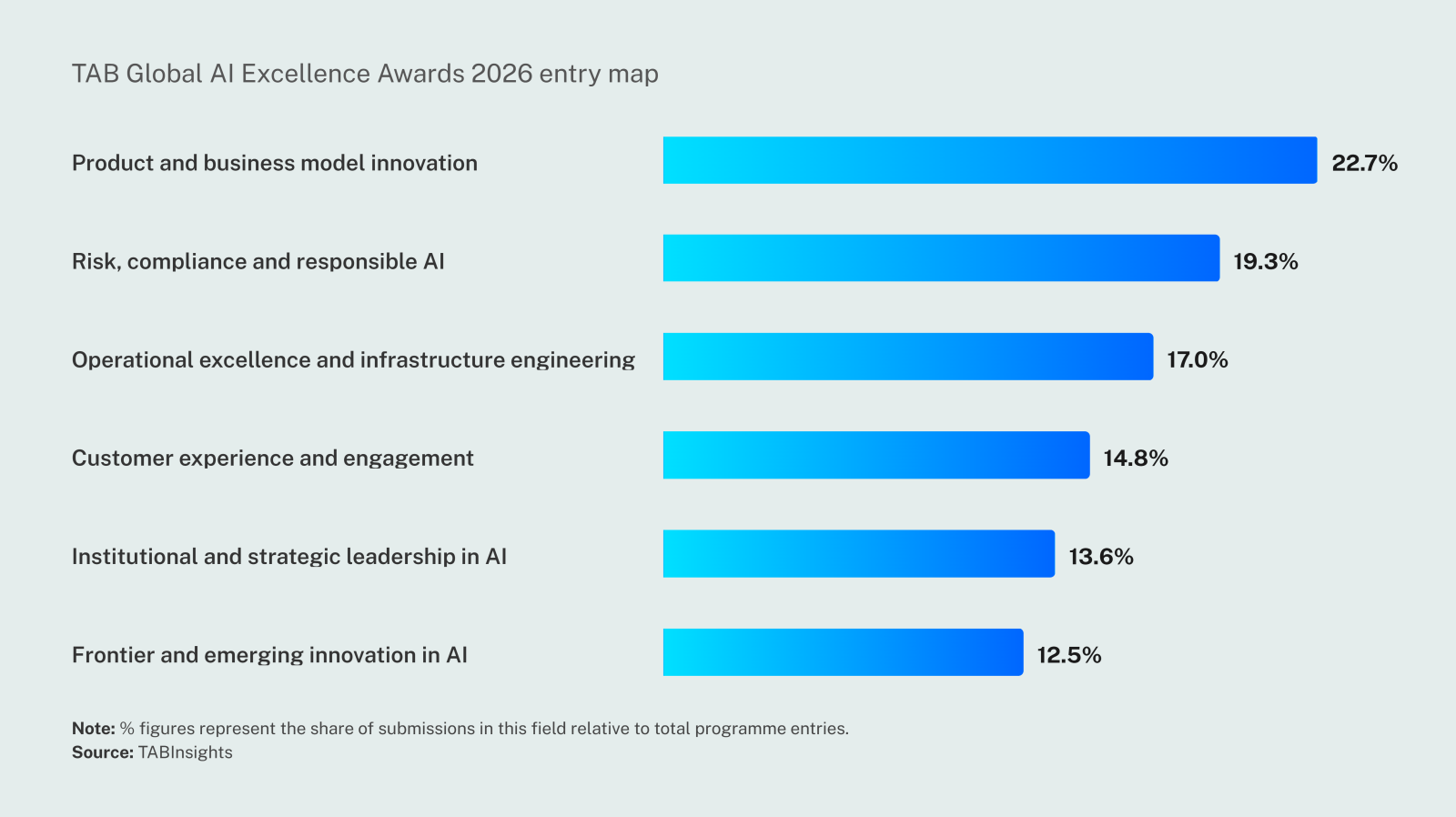
Banks must move fast to adopt new forms of digital currencies and digital assets and modernise their architecture to integrate tokenisation. Rapid developments in AI, digital money and real time banking need are pushing banks to rethink their foundations urgently.
Looking forward, quantum computing is expected to bring new opportunities that could enhance the speed, efficiency and precision of present-day calculations and modelling. Global banks such as JPMorgan have now started exploring quantum algorithms for use cases in portfolio optimisation, option pricing, risk analysis, and applications in machine learning, even though the technology remains experimental. However, banks have yet to begin preparing their cryptographic infrastructure for the post-quantum transition — a gap that will need closing well before quantum computing becomes commercially viable for finance.
Taken together, these trends suggest that an intelligent, real-time bank cannot be built through isolated programmes layered onto old structures. It has to be built from the foundation up — data, architecture, resilience and rails — with everything else, including AI, following from how well that foundation is engineered.
Subscribe for regular insights.









 Google
  LinkedIn