

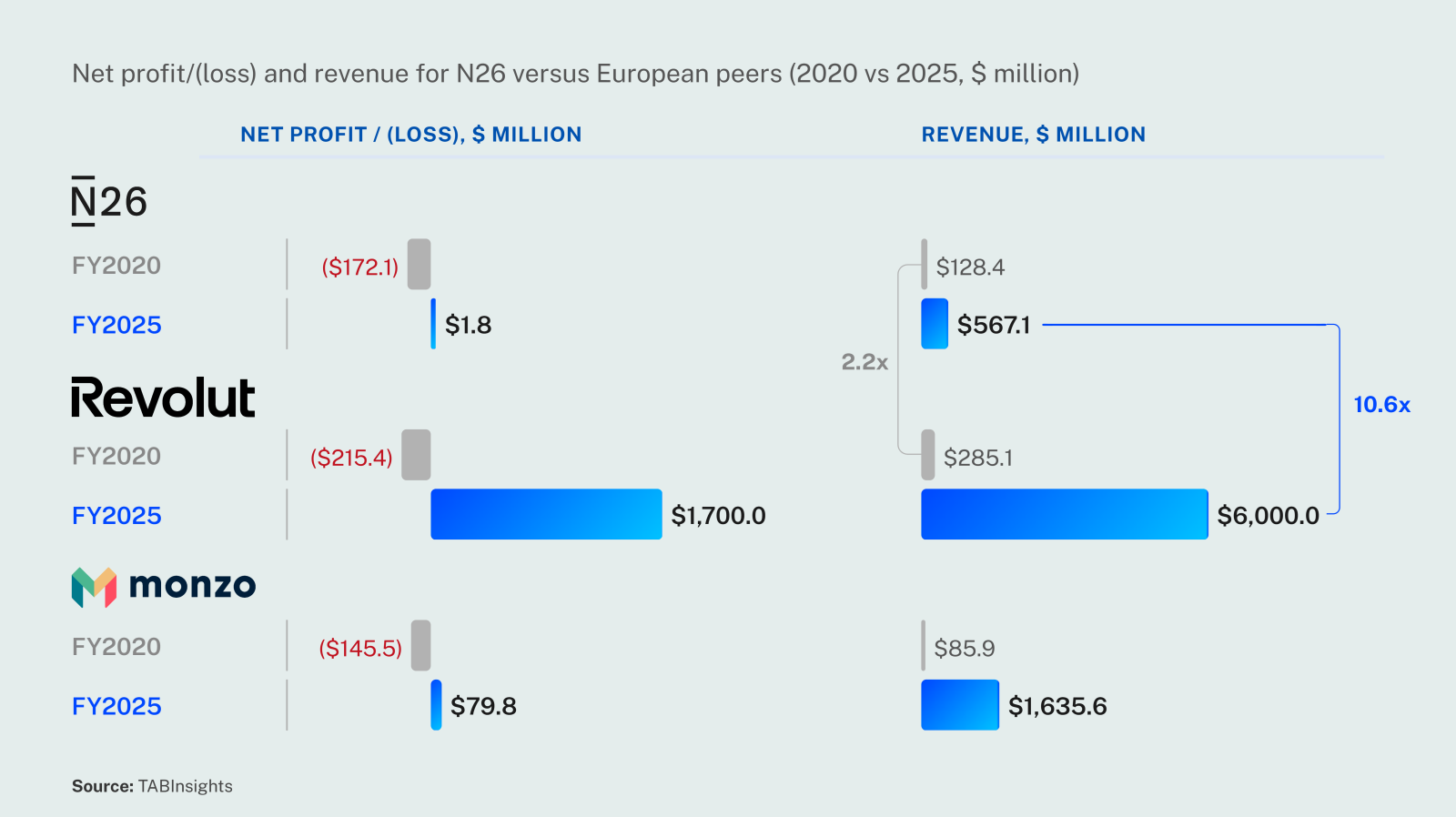

N26's 2025 results tell two stories. The first is a genuine turnaround: revenue surpassed EUR 500 million ($567 million), gross profit rose by a third and the bank recorded its first full-year net profit since its launch in 2015. The second is what that milestone ultimately cost. The digital bank accumulated EUR 1.025 billion ($1.1 billion) in losses between 2015 and 2024. Much of the damage stemmed from Germany's Financial Supervisory Authority (BaFin), which imposed a 32-month customer onboarding cap from October 2021 to June 2024 after identifying systematic failures in anti-money laundering (AML) suspicious activity reporting. N26 also incurred EUR 13.45 million ($14.4 million) in fines between 2021 and 2024. The cap did more than slow customer growth. It coincided with the European Central Bank's (ECB’s) rate-hiking cycle from −0.5% to 4.0%, when deposit-funded net interest income should have transformed N26's economics. Limited to 50,000–70,000 new customers a month instead of its organic run rate of more than 150,000, N26 missed out on hundreds of millions of euros in annualised net interest income at peak rates.
The cap also handed rival Revolut an uncontested three-year window to widen its lead. By 2025, Revolut generated $6 billion in revenue compared with N26's $567 million, a 10.6-fold gap that did not exist in 2020.
N26's 2025 net profit of EUR 1.6 million ($1.8 million) remains modest compared with those of its European digital banking peers. It also came as the bank was replacing its founders, reshaping its boards and bringing in senior executives with expertise in banking, risk, technology and large-scale transformation.
Full-year profitability may mark the end of N26's 11-year start-up phase, but its leadership overhaul shows the journey to becoming a mature bank is far from over.
Profitability at last, but still short of peer scale
N26 generated EUR 501.6 million ($567 million) in revenue in 2025, up 13% from 2024. Lower direct costs lifted gross profit 33% to EUR 350.5 million ($396 million), while group net profit improved by EUR 43.6 million ($49 million), reversing a EUR 42.0 million ($47 million) loss into a EUR 1.6 million ($1.8 million) profit.
Preliminary first-quarter 2026 results pointed to further momentum, with revenue of EUR 130.0 million ($152 million) and group net profit of EUR 9.8 million ($12 million). The trajectory is encouraging, but the comparison below highlights the sizeable financial gap N26 still needs to close with its European digital banking peers.
The lost years reflected governance and business model failures
N26's decade of losses was not caused by weak growth but by governance and business model failures that regulatory intervention made impossible to reverse until 2024. The bank's operating model was already structurally fragile before BaFin intervened in 2021, with many of its weaknesses stemming from decisions by co-founders Valentin Stalf and Maximilian Tayenthal.
Their expansion into the US, Brazil and the UK, without adapting to local market conditions and regulatory requirements, resulted in costly withdrawals from all three markets. The founders' special veto rights over strategic decisions, reinforced by a governance structure that concentrated control in their hands, also delayed the corrective actions sought by investors and regulators.
A business model that monetised too slowly
N26's second weakness was commercial: it struggled to build a high-margin lending business and generate stronger revenue from its customer base.
N26’s customer loan book stood at €3.14 billion ($3.3 billion) at end-2024, larger in absolute terms than Revolut’s $1.2 billion portfolio, but around 93% consisted of municipal loans and Dutch mortgages rather than higher-yielding consumer credit. Revolut’s lending book, though smaller, is almost entirely unsecured consumer and SME credit generating significantly wider spreads. The divergence runs deeper than size. Revolut has built a high-margin, diversified lending engine; N26 anchored its balance sheet in low-risk, low-return fixed income. That structural choice partially explains why N26’s NII recovery, while real, remained constrained even as ECB rates peaked.
Its customer loan book stood at EUR 3.14 billion ($3.3 billion) at the end of 2024, larger than Revolut's $1.2 billion portfolio in absolute terms. However, around 93% comprised municipal loans and Dutch mortgages rather than higher-yielding consumer credit. By contrast, Revolut's lending portfolio is almost entirely unsecured consumer and small and medium-sized enterprises (SME) credit, generating significantly wider spreads. The difference goes beyond portfolio size. Revolut has built a diversified, high-margin lending engine, while N26 anchored its balance sheet in lower-risk, lower-return fixed income, limiting the benefit of higher ECB interest rates despite a recovery in net interest income (NII).
N26 has yet to disclose the size or composition of its year-end 2025 loan book, saying only that net interest income rose 49%, supported by a growing deposit and lending portfolio. There are signs of progress. The bank expanded consumer lending by launching personal loans and overdrafts in Spain in November 2025 alongside existing products in Germany. However, Dutch mortgages remain a significant part of the portfolio, and in December 2025 BaFin barred N26 from issuing new mortgages in the Netherlands after identifying deficiencies in its lending operations.
Monetisation challenges also extended beyond lending. In 2021, N26 had eight million customers but just over 3.7 million revenue-relevant customers. By 2025, that figure had increased to 5.6 million, although the bank no longer disclosed its total registered customer base. Based on year-end revenue, N26 generated roughly EUR 90 ($101) per revenue-relevant customer. While not a true annual revenue-per-user measure, its net profit margin of just 0.3% suggests profitability remained extremely thin despite the bank's first full-year profit.
Subscription income tells a similar story. Premium account fees contributed EUR 68.3 million ($73.9 million), or around 15% of revenue, in 2024, although N26 did not disclose the figure separately for 2025. By comparison, Revolut's subscription revenue rose 74% to $541 million in 2024, accounting for about 14% of its $4.0 billion revenue and exceeding N26's premium account fees by more than sevenfold. Paid-plan adoption at Revolut grew 45% in 2024 and 42% in 2025, demonstrating the benefits of stronger customer monetisation and cross-selling. N26 reported higher premium revenue and customer uptake, but its disclosures do not indicate whether paid-plan conversion approached Revolut's levels.
New management begins correcting past mistakes
N26 is beginning to address these weaknesses. In 2025, growth in revenue-relevant customers, subscriptions and card activity drove fee income, while treasury operations and lending lifted net interest income. Its product roadmap now extends beyond everyday banking to savings, investments, credit and lifestyle services. Net fee and commission income rose 21% and accounted for 53% of gross profit, while net interest income increased 49%.
Even so, Revolut's 2025 results show how much ground N26 still has to cover. Eleven of Revolut's product lines each generated more than GBP 100 million ($134 million) in annual revenue, highlighting the scale and diversification that N26 has yet to achieve.
The management reset from December 2025 to July 2026
Taken together, the appointments mark a deliberate shift from founder-led entrepreneurship to professional bank management while strengthening accountability. Mike Dargan oversees the core markets; Aytac Aydin leads technology, operations and legal; Daniel Lappas combines product with commercial strategy; Jochen Klöpper anchors risk; and the Supervisory Board has been strengthened with former regulators, bankers, operators and technology leaders. It is the governance architecture N26 arguably needed years earlier.
- 15 Dec 2025: Mike Dargan appointed sole CEO. The former UBS group chief operations and technology officer was named CEO of N26 SE and N26 Bank SE from April 2026, subject to BaFin approval, succeeding Maximilian Tayenthal and Marcus W. Mosen.
- 30 Dec 2025: The founder era ends operationally. Tayenthal stepped down on 31 December. CFO Arnd Schwierholz and Mosen became interim co-CEOs; Jochen Klöpper, who had started as chief risk officer on 1 December, joined them on the Management Board.
- 2 Mar 2026: Supervisory boards aligned. Transformation specialist Stefan Ermisch replaced Peter Kleinschmidt, making the boards of N26 SE and N26 Bank SE identical and strengthening institutional banking experience.
- 20 May 2026: Operations and product authority consolidated. Aytac Aydin was appointed chief operating officer and managing director; Daniel Lappas became chief product and business officer. The general managers of France, Italy and Spain were set to report directly to Dargan.
- 29 Jun 2026: Board expertise broadened. Marieke Flament and Andreas H. Tuczka joined the Supervisory Board, adding technology, AI, digital banking, regulation, capital-markets and credit experience.
- 14 Jul 2026: Growth and technology leadership refreshed. Nathalie Picquot was named incoming chief growth and marketing officer and Marcin Pakulnicki incoming chief technology officer. Timo Meyer and Gino Cordt will leave their roles at the end of 2026.
- 15 Jul 2026: The interim transition closes. Mosen stepped down from the Management Board and operational responsibilities, describing N26’s evolution towards a more manager-led model with stronger governance and risk awareness.
Profit buys time but trust determines the outcome
N26's first full year of profitability deserves recognition. The results suggest its operating leverage is finally taking hold. The bigger question is whether customers, regulators and investors will believe the bank's new governance structure can prevent another cycle of regulatory remediation.
The lesson extends beyond N26. Digital banks cannot afford to bolt on controls after achieving scale. Compliance, risk governance and complaint handling are not costs that compete with growth; they are the foundations that make growth durable. N26 proved it could build a compelling digital banking product. Its new management team must now prove it can turn that demand into trust, deeper customer relationships and sustained profitability.
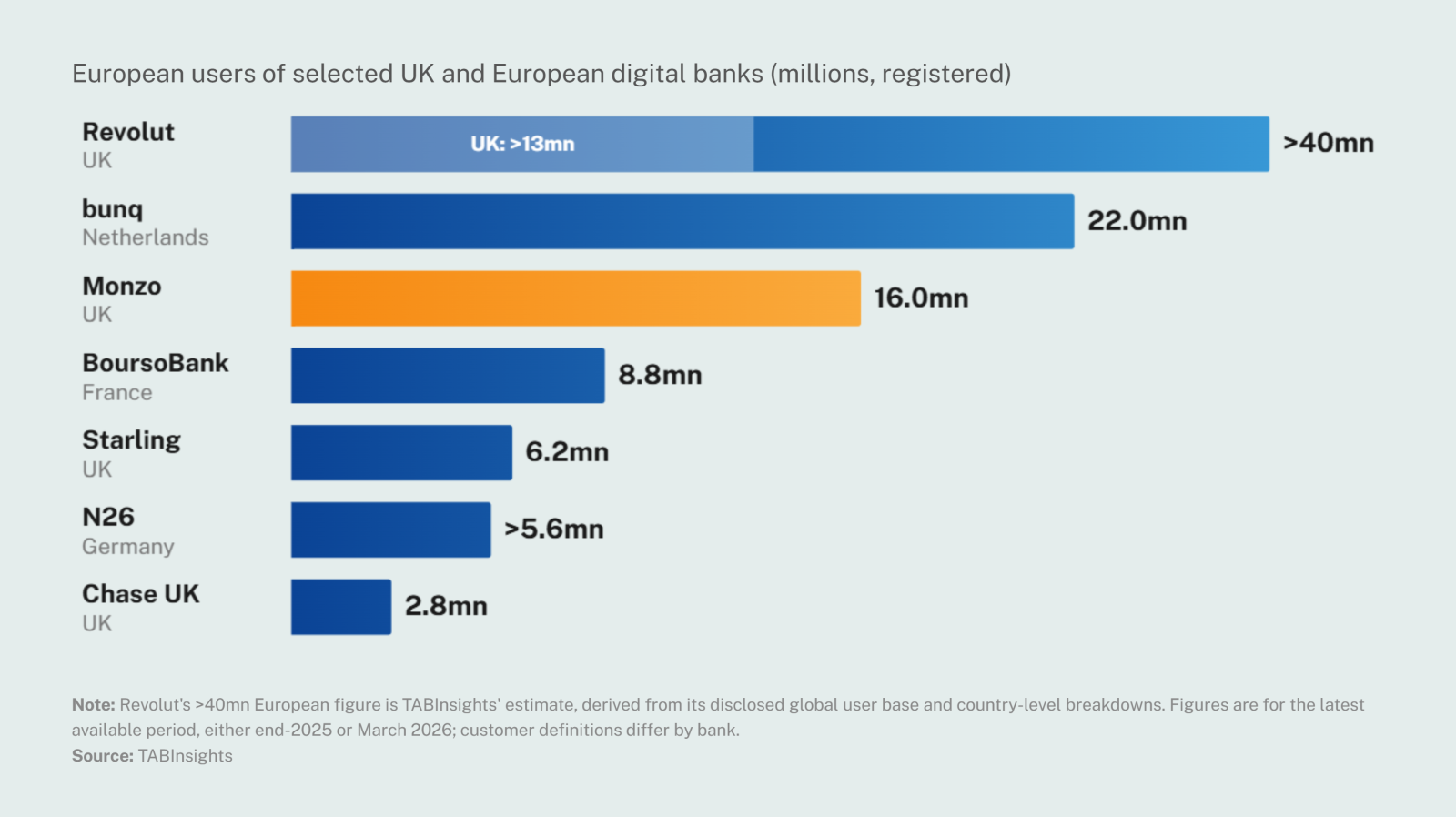
Outside its home market of Germany, N26 has yet to establish a leadership position in Europe, while Revolut says it is the most downloaded finance app, ranking first in 15 countries and among the top three in 26 across the continent. N26's 2025 profit is an important milestone, but its leadership overhaul is the more significant indicator of whether the bank can close the gap with its peers.
Subscribe for regular insights.



Banner.png)



.png)





 Google
  LinkedIn